
The Whats and Wheres of North American Indigenous Baskets
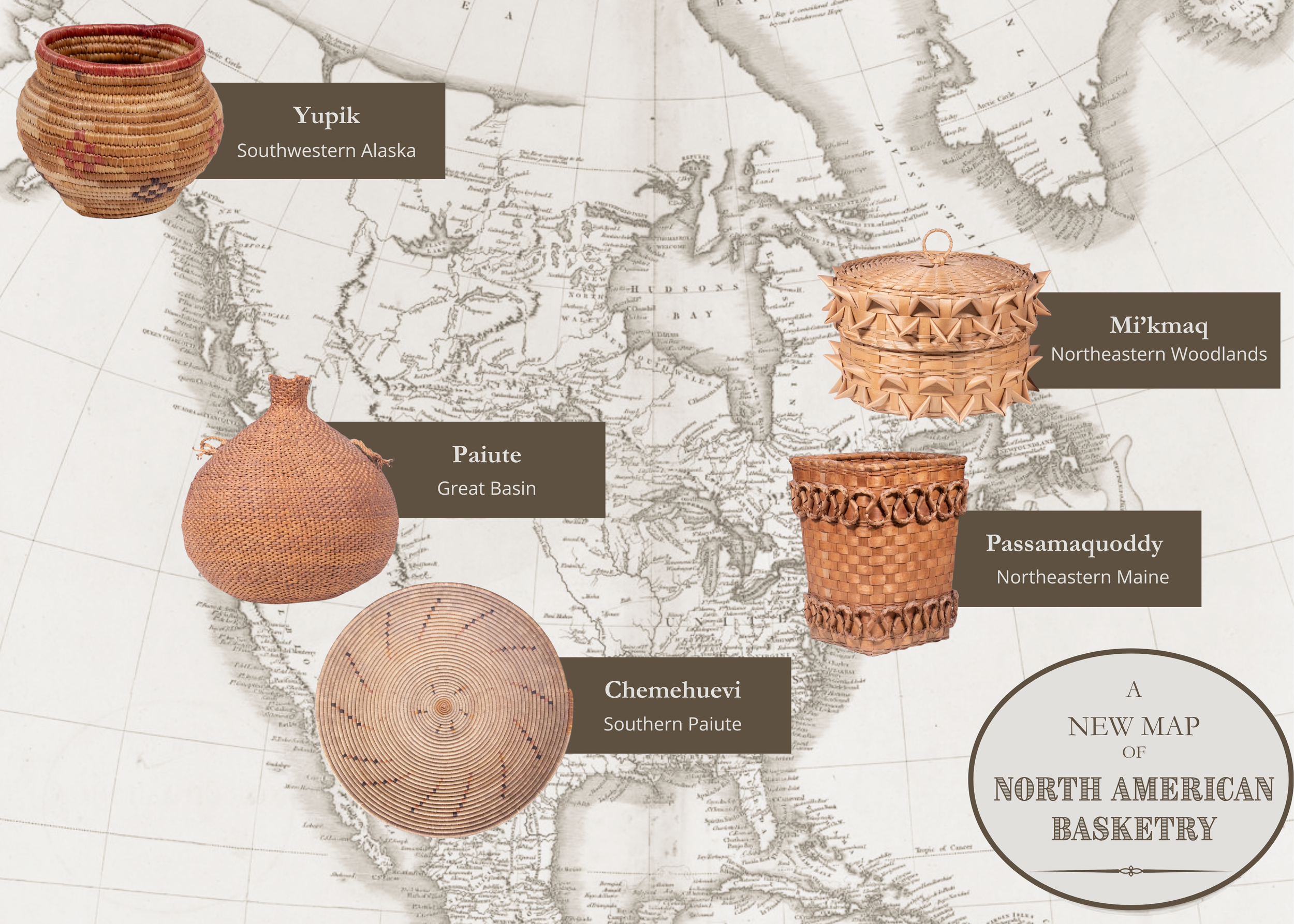
Widely collected for well over a century, but with a heritage extending to antiquity, baskets created by the native peoples of North America are objects of both distinctive beauty and practical utility. From the familiar over-and-under splint baskets common to the peoples of the Northeastern Woodlands of North America, to the ornate, tightly woven designs characteristic of the native peoples of the Pacific Coast, indigenous basketry offers a fascinating scope of variations.
Passamaquoddy
Northeastern Maine
Basket-making techniques evolved according to the raw materials available in any given area. Baskets created in the Northeastern domain of the Wabanaki Confederacy feature a sturdy, practical style, fashioned from thin, flexible splints split from selected brown ash trees, a tree which once grew in abundance across the Wabanaki territory, and which held a significant place in the spiritual life of the peoples who worked the wood. Baskets became an important trade item early in the period of European colonization, and basketmakers evolved their technique to feature distinctive ornamentations and embellishments designed to appeal to European traders.
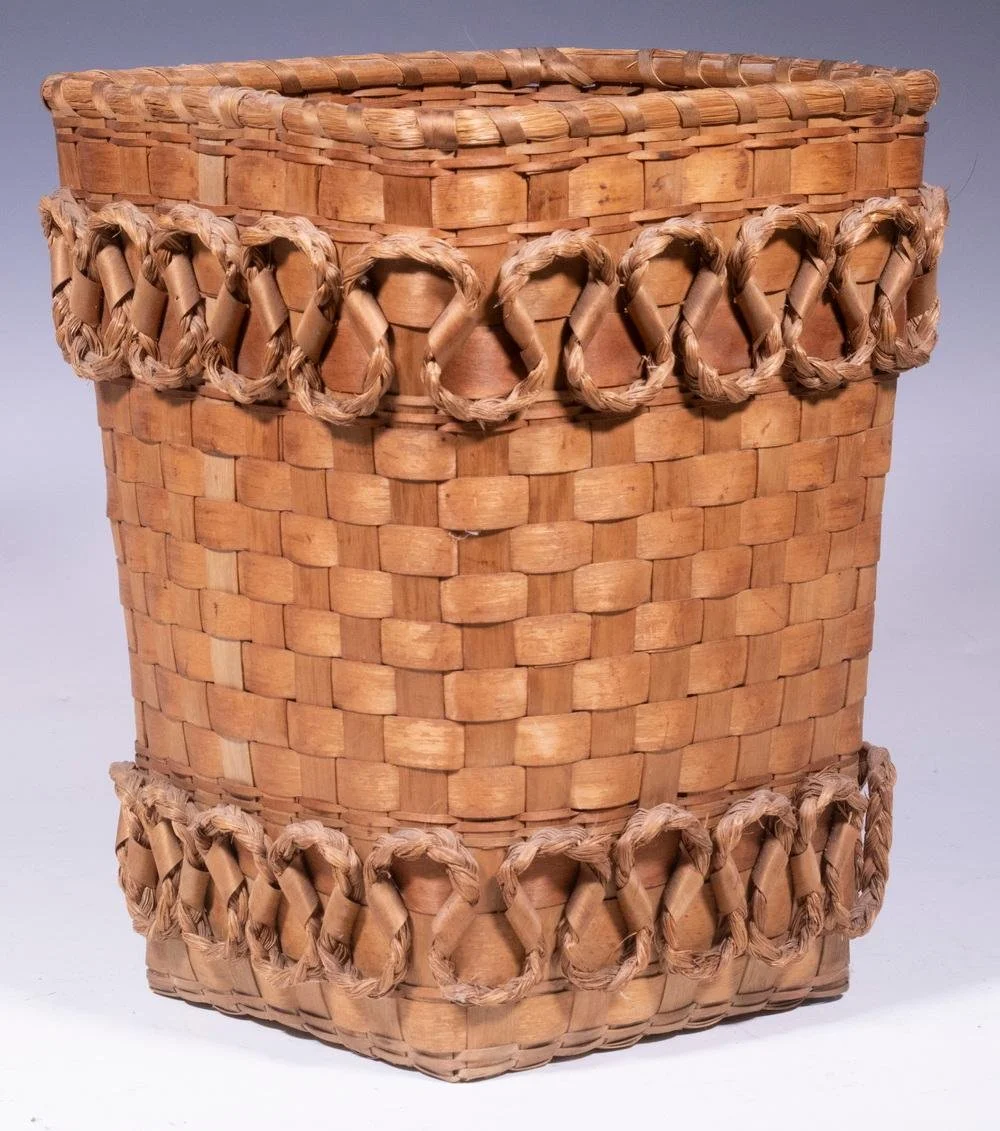
1920s Maine Passamaquoddy Waste Basket. Ornamented with an applied double-wave motif created from pine needles, this ash-splint basket is typical of items created for sale in response to 20th Century collector interest in Indigenous basketry.
Paiute
Great Basin
Across the continent, in the arid country of the Great Basin, twined and woven grasses were favored by the Paiute peoples for the creation of water baskets. Thin strips of plant fiber, often willow or sumac, were twisted, wrapped, and woven together to create a flexible yet tightly constructed vessel, made watertight by a thin coating of clay mixed with hot pitch. The resulting bottle-shaped container could be filled with water, and reliably transported for daily use or stored against the inevitable droughts.
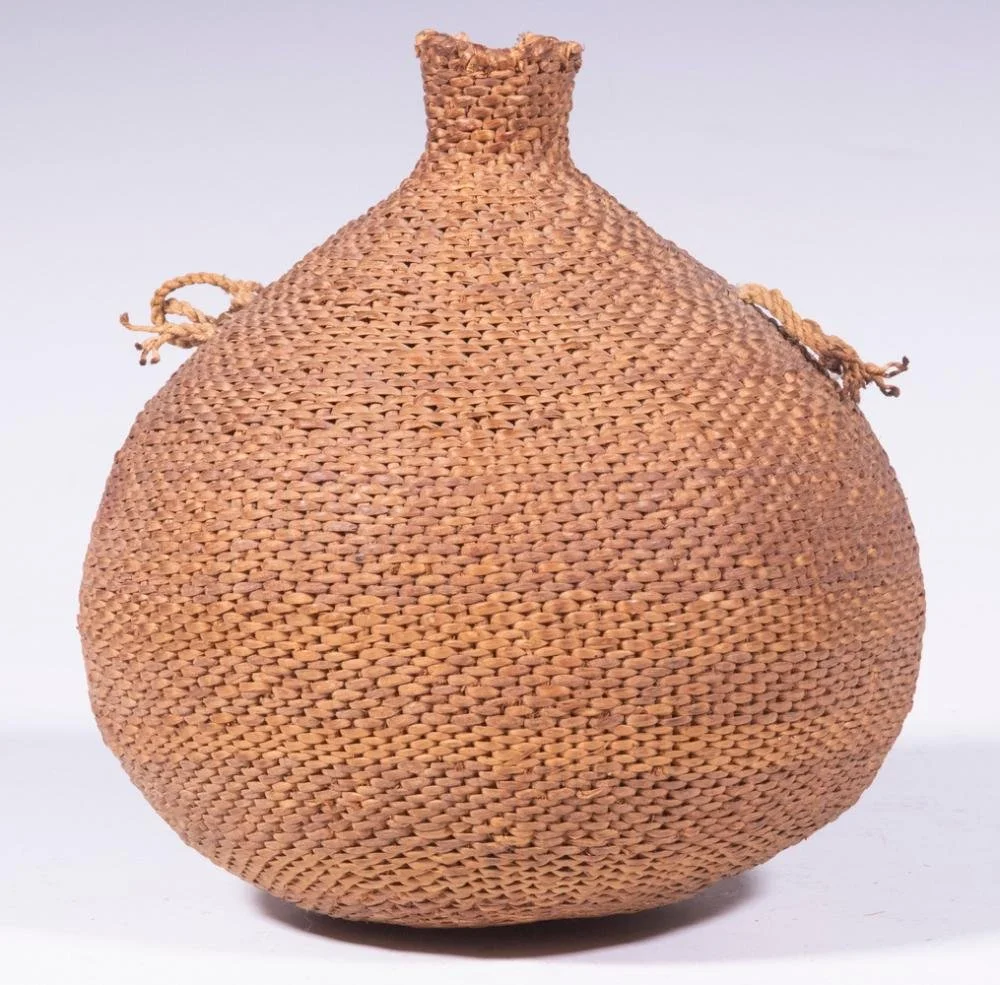
Vintage Native American Basket. This Paiute water canteen from the late 19th century displays the characteristic tight twining which lent itself to waterproofing.
Chemehuevi
Southern Paite
In the Southwest, coiled, plaited, and twined methods of construction were all used for various purposes by Indigenous peoples, with the familiar tray-shaped coiled baskets of the region created in various styles by the Navajo, Apache, Hopi, Chemeheuvi,and Yavapai peoples. Originally used for winnowing grain, serving food, and other practical purposes, as well as for ceremonial use, the low, circular coiled baskets, embellished with bold geometric designs, were also produced specifically for trade as decorative objects.
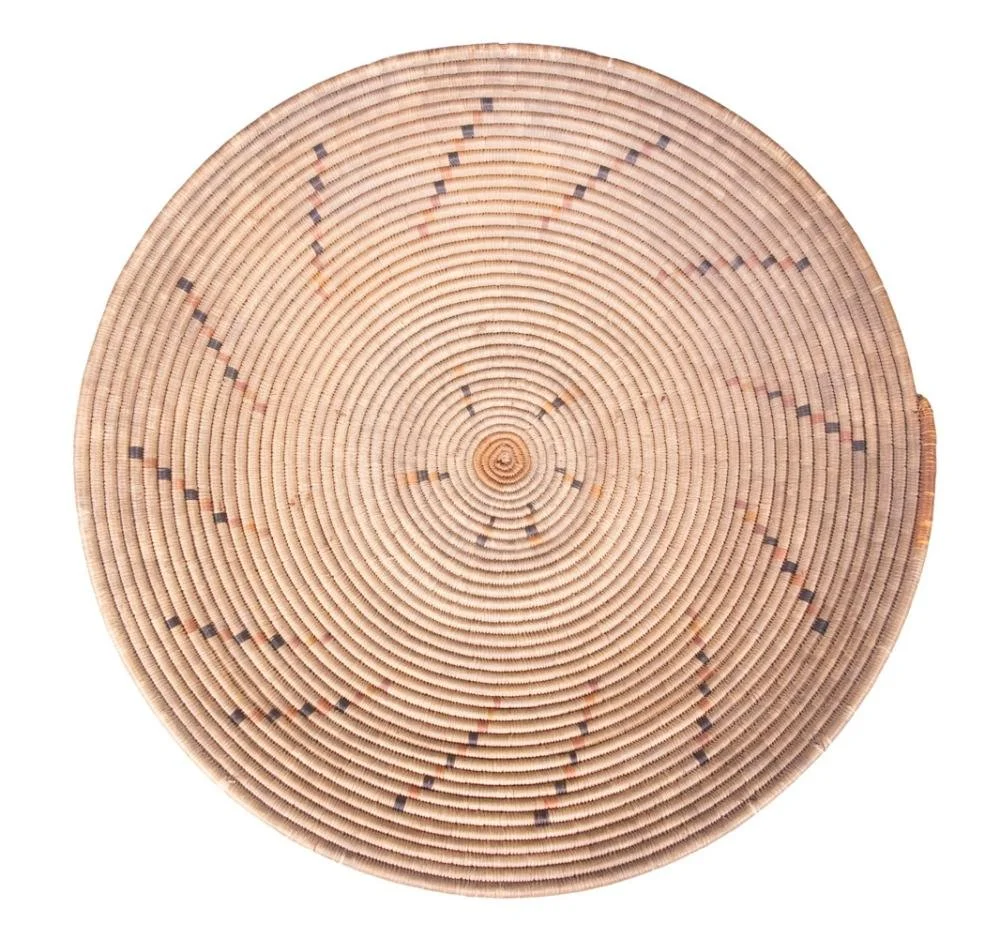
Large Early 20th Century Coil Built Native American Tray. Attributed to the Chemeheuvi people of the Lake Havasu area.
Yupik
Southwestern Alaska
Northward into Alaska, Yupik, Aleut, Tlingit, and Haida artisans worked largely in tundra grasses, tree bark, and roots, constructing bulbous lidded baskets from tight coils of fiber, wound carefully from the bottom upward and carefully stitched with threads of skin or yarn. Vegetable dyes worked into the weave or applied with stitching embellished these baskets with colorful geometric designs.
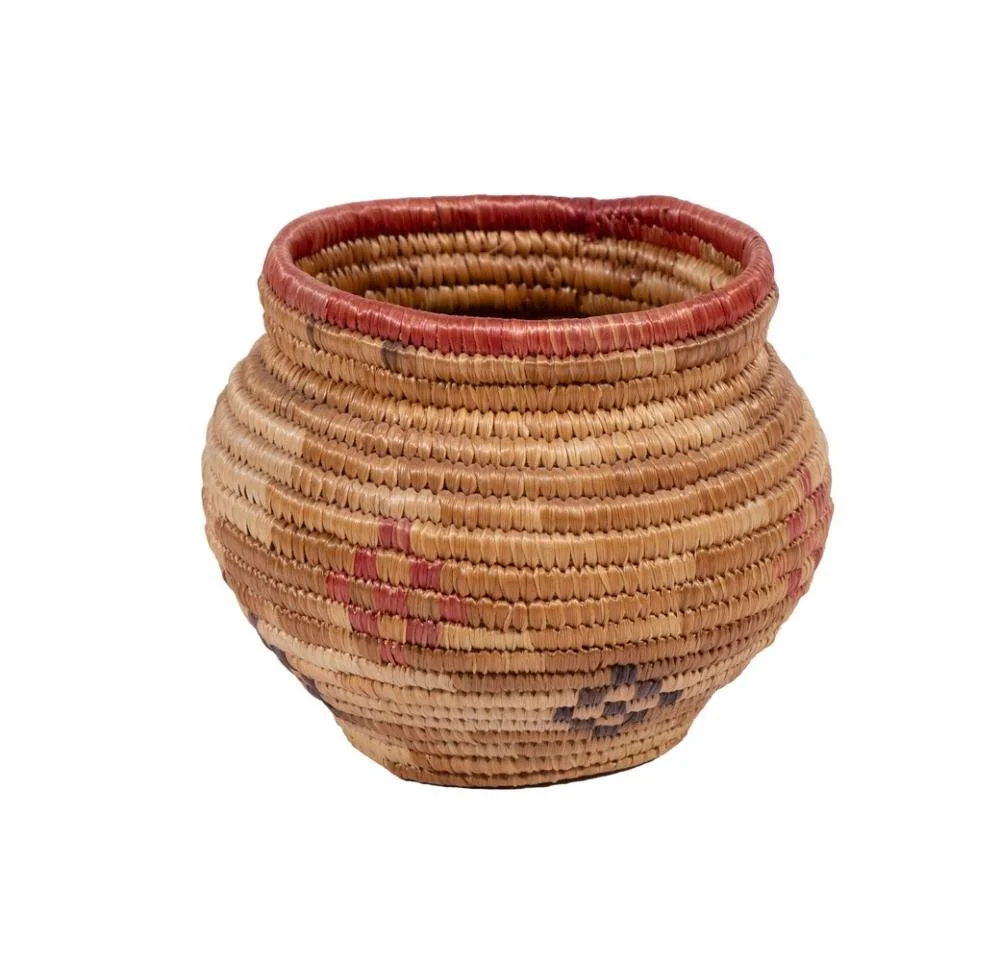
Yupik Native American Coiled Basket. A piece demonstrating the technique of coiled construction accented with geometric color patterns.
Mi’kmaq
Northeastern Woodlands
Basketmaking was a vital element of trade between Indigenous peoples and Europeans almost from the dawn of the colonial era. But the collecting and cataloguing of baskets on a widespread, organized basis by non-Indigenous people was largely a development of the late 19th and early 20th centuries. "Basket connoisseurs" in California were responsible for the early spread of the craze around 1900, with one newspaper account noting with amazement that a basket purchased from its maker in Northern California in 1885 for fifty cents had recently sold for $380, a sum roughly equivalent to $15,000 in 21st century money. As interest crested during the 1910s and 1920s, basket makers on both sides of the continent responded to the increased demand by commercializing their own wares, producing baskets to standard patterns for sale at roadside stands and gift shops, occasionally taking special commission orders for favored customers. These stands and shops remained a distinctive feature of American motor travel for the rest of the 20th century.
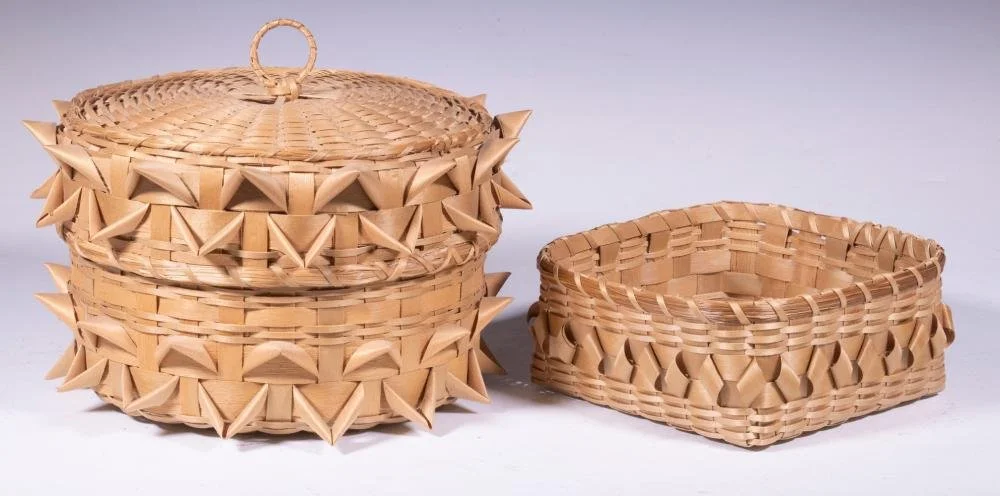
2 Native American Baskets. These two contemporary-era Mi'kmaq baskets, constructed in the traditional manner with ash splints and embellished in the twisted-splint "porcupine" pattern, bear the signature of Jane Zumbrunnen of Presque Isle, Maine, a Wabanaki artisan who learned the art of basketmaking from a family elder and who, in turn, passed the skill along to younger apprentices to carry the tradition forward for future generations.
Basket production for many Indigenous peoples became an essential element in their economic survival. Today, collectors continue to appreciate the beauty and craftsmanship of Indigenous basketry, coupled with acknowledgement of and respect for the peoples who introduced, developed, and mastered this art. We’re pleased to offer these distinctive pieces for your consideration in our North American Collection Auction.
North American Collection
Date & Time: Friday, May 15th - 11 AM EDT
Location: Thomaston Place Auction Galleries, 51 Atlantic Highway, Thomaston, Maine
Bidding Options: In-person, by phone, or by absentee bid. Online bidding options are available at thomastonauction.com
Preview: Open to the Public, Monday, May 11th through Thursday, May 14th, 11 AM to 5 PM EDT
For details on how to participate, visit our How to Bid page or complete the Phone/Absentee Bid Form to register. With limited seating and phone lines available, collectors are encouraged to register early to secure participation.
References
Turnbaugh, Sarah Peabody and William A., "Discovering American Indian Baskets." Journal of Antiques and Collectibles, 7/7/2014.
"Indian Basket Makers -- Micmac," in the Northeast Archives of Folklore and Oral History. Interviews with apprentice basket makers Sylvia Gabriel and Yvonne Nadeau, discussing their apprenticeship under Jane Zambrunnen.
"Artistic Indian Baskets In Demand at High Prices," 9/1/1900. The Sacramento Bee, Sacramento, CA.